
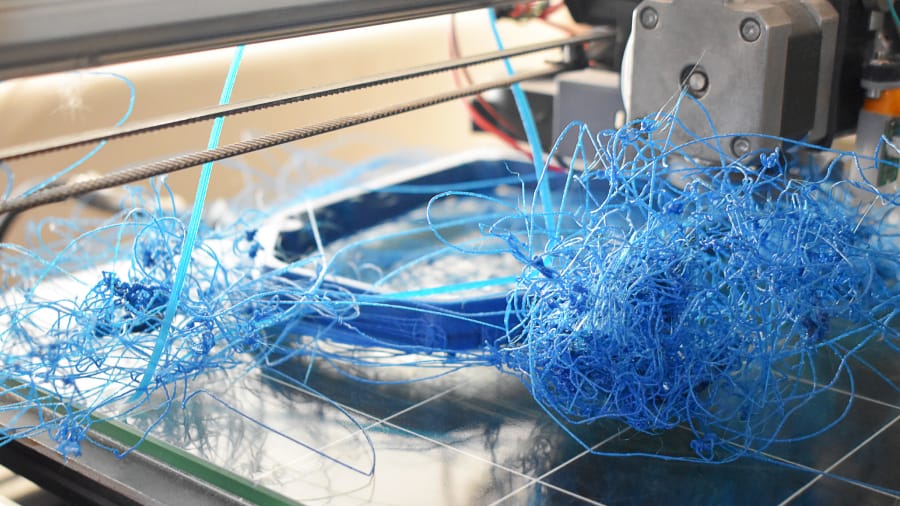
Bed adhesion problems, incorrect temperature settings, or poor support placement are usually responsible for 3D print failures; these issues are prevented by professional services through calibrated equipment, proper material handling, and experience-based troubleshooting that most home setups can’t match.
Fast Facts
- Approximately 40% of all 3D printing failures are caused by bed adhesion issues
- Print quality and layer bonding can be ruined by temperature variations of just 5°C
- 95%+ success rates are achieved by professional services vs. 60-70% for typical home printers
- 25% of complex print problems are accounted for by support structure failures
- 30% of failed prints are affected by filament quality and storage conditions
Understanding Bed Adhesion Problems
That crucial first layer is where the foundation of any successful 3D print starts. Everything else becomes pointless when prints don’t stick to the build platform properly. This challenge is often faced by home printers because bed leveling requires precision that’s hard to maintain over time.
Heated beds that are calibrated regularly and maintained at exact temperatures are used by professional services. Which adhesion methods work best for different materials is also known by them. A student in St Catharines recently told us her home printer worked fine for PLA but failed every time with PETG; the issue was bed preparation, not the printer itself.
Temperature Control and Consistency
More prints are killed by temperature swings than people realize. Your extruder might show 210°C, but actual temperatures can vary by 10-15 degrees during printing. Through thermal imaging studies of consumer-grade printers, this inconsistency was discovered.
Tighter temperature control is maintained by professional equipment through better heating elements and environmental management. When a local inventor brought us a complex prototype that kept failing at home, his printer’s temperature was found to be fluctuating enough to cause layer separation. On our calibrated system, the part printed perfectly.
Support Structure Challenges
Supports are necessary for overhangs and bridges. They’re also where many prints go wrong, though. Too few supports and your print collapses mid-way through; too many and you’ll spend hours removing them, often damaging your part in the process.
Specialized software that calculates optimal support placement based on geometry and material properties is used by professional services. Hobbyists have been seen struggling for weeks with a design that printed flawlessly once the supports were positioned correctly. Experience makes the difference here.
Filament Quality and Storage Issues
Not all filament is created equal. Even good filament can become problematic if stored incorrectly, though. Print quality is silently killed by moisture absorption, causing bubbling, poor layer adhesion, and inconsistent extrusion.
Controlled storage environments are maintained by professional services, and commercial-grade materials that aren’t available to consumers are often used. A small business owner from the area learned this when his “budget” filament kept producing weak prototypes. With quality materials, the same design printed 40% stronger.
Layer Adhesion and Print Speed Problems
Printing too fast is tempting when you’re eager to see results; it often leads to poor layer bonding, however. Time to properly fuse with the one below it is needed by each layer. Speeds beyond what their setup can handle reliably are frequently pushed by home users.
Speed with quality based on part requirements is balanced by professional services. How different materials behave at various speeds is also understood by them. What works for a simple prototype might not work for a functional part that needs strength. This kind of nuanced approach is required by custom 3D printing.
Environmental Factors and Consistency
Room temperature, humidity, and air currents all affect print quality in ways that aren’t immediately obvious. Warping can be caused by a draft from an air conditioning vent. Filament can be made to behave unpredictably by high humidity.
These variables are controlled by professional facilities through dedicated printing environments. Conditions throughout long prints are also monitored by them to catch problems early. When you’re working on important prototypes or custom parts, I suppose these details matter more than you might expect. If you’re ready to skip the troubleshooting and get reliable results, visit our website to discuss your project.
Mini-FAQ
Q: What’s the most common reason 3D prints fail?
Poor bed adhesion tops the list. The first layer needs to stick perfectly, or everything falls apart. Temperature inconsistencies make it worse.
Q: Can I fix warping issues on my home printer?
Look, warping happens when different parts of your print cool at different rates. You can try enclosures or heated beds, but it’s tricky to get right. Professional setups are designed to handle this.
Q: Why do my supports always break or leave marks?
Support placement is part art, part science. Too little and your print collapses; too much and you damage the surface removing them. Getting it right takes practice.
Q: Are professional 3D printing services worth the cost?
When you factor in failed prints, wasted filament, and time, professional services often cost less than doing it yourself. Plus you get better results.