
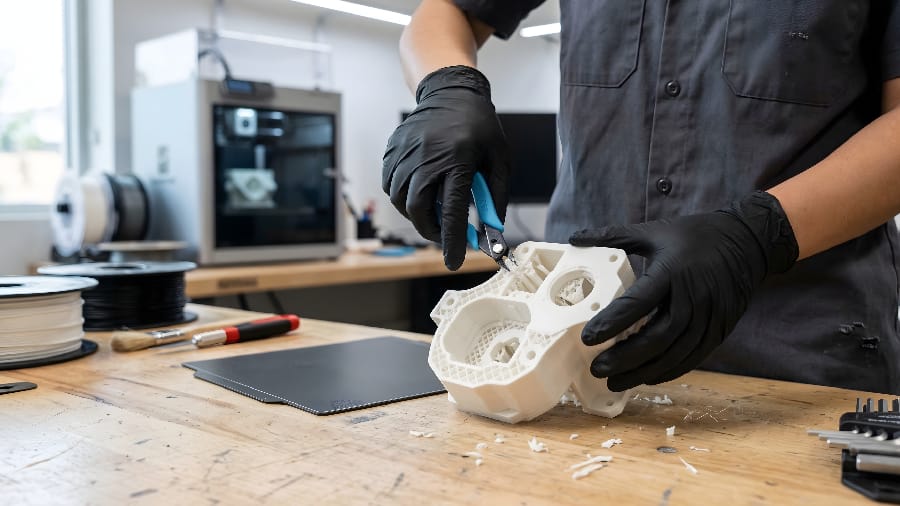
3D printed parts can be quite strong, usually ranging from 20-80% the strength of traditionally manufactured parts depending on material and print quality. Around 50 MPa of tensile strength is handled by PLA parts; PETG and ABS can reach 70+ MPa with proper settings. The key factors are material choice, layer adhesion, and print orientation… though working with an experienced service often makes the difference.
Fast Facts:
- 3,000-5,000 PSI of stress is typically withstood by PLA parts before breaking
- PETG offers 40% better impact resistance than standard PLA
- Part strength can be changed by up to 300% through print orientation
- Some metals are matched by professional-grade materials like carbon fiber composites
- Strength gets affected by layer height more than most people realize
Understanding 3D Print Strength Basics
Pretty often, the strength of 3D printed parts gets misunderstood. Many people think they’re automatically weak because they’re plastic; that’s not quite right, though. Modern 3D printing materials can be surprisingly tough when they’re printed correctly.
Layer adhesion is the real issue. Each layer needs to bond properly with the one below it. When that happens, parts that can handle serious stress are what you get. When it doesn’t, things fall apart quickly. Temperature, speed, and material choice all play into this.
Material Choices Make All the Difference
PLA is the beginner-friendly option, and it’s stronger than most people give it credit for. About 50 MPa of tensile strength is handled by it, which works fine for brackets, housings, and decorative parts. Plus it’s easy to print with.
Things get stepped up considerably by PETG. It’s tougher, more flexible, and impact is handled better. We see it used for functional parts that need to flex without breaking. ABS is another step up, I suppose, especially for parts that see heat or outdoor use.
For serious applications, materials like carbon fiber composites or glass-filled nylon are available. Some aluminum alloys can be matched by these in strength. But specialized equipment and experience are needed to print them well.
When 3D Printing Makes Perfect Sense
Where 3D printing really shines is prototyping. You can test fit, function, and durability before expensive tooling is committed to. A student in St. Catharines recently printed 15 iterations of a phone case design before getting it just right. That kind of rapid iteration is nearly impossible with traditional manufacturing.
Another sweet spot is custom parts. Need a replacement part for an old appliance? Want a bracket that fits your exact setup? One-off projects are handled beautifully by 3D printing. The setup costs are minimal compared to injection molding.
Small batch production works well too, especially for specialized items. If 50 custom jigs are needed for a workshop, 3D printing often beats machining on cost and timeline.
Where Traditional Manufacturing Still Wins
High-volume production usually favors injection molding once certain quantities are hit. The per-part cost drops dramatically after the initial tooling investment. For thousands of identical parts, more financial sense is typically made by traditional methods.
Careful consideration is needed for critical safety components. While 3D printed parts can be strong, potential failure points are created by the layer-to-layer bonds. Different manufacturing approaches are often required by aerospace and medical applications for liability reasons.
Precision requirements can be challenging too, in a way. Tolerances are had by 3D printers, and tight fits sometimes require post-processing. Better dimensions are often held by machined parts straight off the equipment.
Getting the Strength You Actually Need
More than most people realize, print orientation matters. A part printed standing up might be three times stronger than the same part printed flat. The layers stack differently; that changes how forces get distributed.
Adjustable strength controls are wall thickness and infill percentage. Stronger parts are meant by more walls and higher infill, but also longer print times and more material. Some experience is taken by finding the right balance.
A lot of trial and error can be saved by working with a knowledgeable 3D printing service. How different materials behave is understood by them, and design changes that improve strength without adding cost can be suggested.
Making the Right Choice for Your Project
Your actual requirements should be considered, not just what seems strongest. A prototype doesn’t need to last 10 years. Light loads might only be seen by a custom bracket. Better results usually come from matching the solution to the real-world need.
Quantities should be thought about too. One custom part? Your best bet is probably 3D printing. A thousand identical parts? More sense might be made by traditional manufacturing. The crossover point varies by complexity and material.
If strength requirements or material choices are uncertain, things can be clarified quickly by talking through your project with an experienced service. These decisions are guided by us regularly, and the right approach becomes clearer once all the factors are on the table. Visit our website to discuss your specific needs and get expert guidance on material selection and design optimization.
Mini-FAQ:
Q: Are 3D printed parts as strong as injection molded ones?
Generally speaking, they’re about 60-80% as strong when printed with similar materials. Natural weak points are created by the layer-by-layer construction that solid molding doesn’t have. But for prototypes and custom parts, that’s usually more than enough.
Q: What’s the strongest 3D printing material for hobbyists?
The best balance of strength and printability for most projects is struck by PETG. It’s tougher than PLA but easier to work with than ABS. Carbon fiber filaments are stronger but need specialized equipment.
Q: Do 3D printed parts break easily?
Fair point to ask. Most failures happen because of poor print settings or wrong material choice, not because the technology is weak. Years of normal use can be handled by a well-printed part. That still surprises people.
Q: Can 3D printed parts replace metal components?
Look, it depends on the application. For low-stress situations, absolutely. Impressive loads can be handled by high-performance plastics. But for critical mechanical parts or high-heat environments, metal usually wins.