
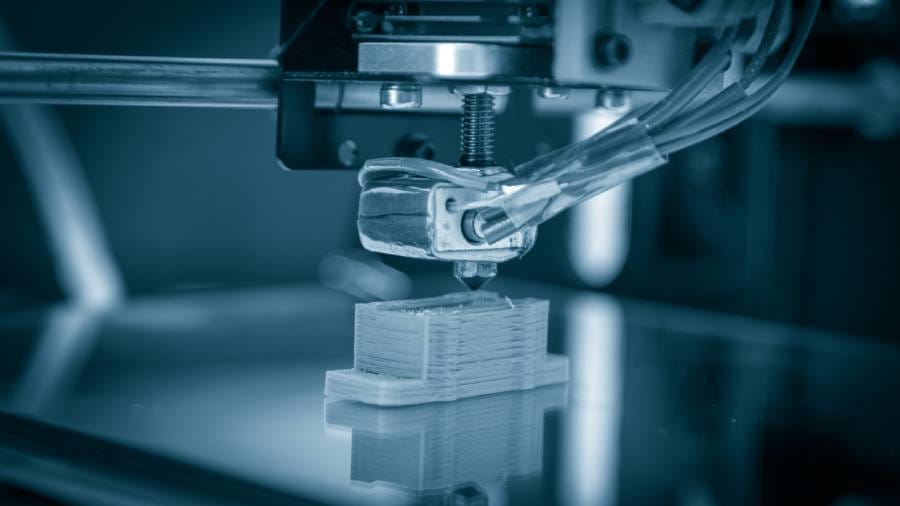
Design complexity and material choice typically determine turnaround time for 3D printing services in Ontario, which ranges from 2-7 business days. Cost varies from $15-200+ per part; the service provider’s equipment and experience heavily influence quality. Simple prototypes are printed faster and cost less, while more time and expertise are required by detailed custom parts.
Fast Facts
- Simple parts are completed by most Ontario 3D printing services within 48-72 hours
- 2-4 days can be added to production time by complex designs with support structures
- Material costs range from $2/hour for PLA to $8/hour for specialty filaments
- Both quality and timeline are affected by print resolution (0.1mm layers take 3x longer than 0.3mm)
- Rush orders typically cost 50-100% more but turnaround can be reduced to 24 hours
Understanding Design Complexity Impact
Everything else is driven by your part’s geometry. Minimal support material is needed when simple boxes and cylinders are printed quickly. But overhangs, thin walls, or intricate details are added and the timeline stretches considerably. Hobbyists in St. Catharines have been seen surprised when their “simple” phone case takes three days instead of one. Internal channels that required dissolvable supports were the issue.
Cost is affected by complexity through material waste and labor time. Support structures get printed then removed; this means plastic that gets thrown away is what you’re paying for. Plus, skill and time are taken by removing supports carefully.
Material Selection and Its Consequences
Most prototypes still use PLA as the go-to choice. Fast printing is provided, less cost is involved, and form and fit testing works well with it. But functional parts that need strength or heat resistance aren’t suitable for it.
More cost is associated with ABS and longer printing time is taken due to warping issues. A middle ground is offered by PETG with better strength than PLA but easier printing than ABS. Your costs and timeline can be doubled by specialty materials like carbon fiber or wood-filled filaments. According to available data, project costs can be swung by 200-300% through material choice alone.
Service Provider Capabilities Matter
Equal creation isn’t found among all 3D printing services. Single desktop printers in basements are operated by some, while industrial-grade equipment with climate control is run by others. Consistency and quality show the difference.
Design assistance is typically offered by professional services and problems can be spotted before printing starts. Time and money are saved compared to trial-and-error approaches. How design assistance helped turn a failed prototype into a working solution in half the expected time was recently told to us by a student from Brock University.
Geographic Factors in Ontario
Both shipping costs and turnaround times are affected by location. More equipment options might be had by services in Toronto or Ottawa, but 1-2 days each way are added by shipping. More personal attention and faster communication are often offered by local providers in smaller cities like St. Catharines.
A role is played by seasonal factors too. Winter shipping delays are common across Ontario; busier periods during university project seasons in fall and spring are experienced by many services.
Quality Control and Post-Processing
More than just the printer determines print quality. Different approaches are required by layer adhesion, surface finish, and dimensional accuracy. Parts are rushed out the door by some services with visible layer lines and rough surfaces.
Support removal, sanding, and sometimes vapor smoothing or painting are included in quality post-processing. Time is added by these steps but the difference between a prototype and a finished product is made. In many cases, post-processing options aren’t realized to exist by customers until the raw print quality is seen.
Balancing Speed, Cost, and Quality
Perfect application to 3D printing is made by the classic project management triangle. Fast, cheap, or high quality can be had, but all three simultaneously is rare. Some quality control steps are typically sacrificed by rush orders to meet deadlines.
Prioritization based on their project stage is done by smart customers. Speed and cost over perfect surface finish might be prioritized by early prototypes. The extra time and expense for better quality are justified by final prototypes or end-use parts. Best results from rapid prototyping are achieved when expectations match the service level.
Making the Right Choice for Your Project
Defining what success looks like for your specific project should be your starting point. Different requirements are had by a functional test part than a presentation model or end-use component.
Questions about their quality control process, typical turnaround times, and material options should be asked of potential providers. Questions about your intended use will be asked by good services and appropriate materials and settings will be suggested. If reliable 3D printing services in Ontario with design assistance and quality focus are what you’re looking for, I suppose, visit our website to discuss your project needs.
Mini-FAQ
Q: How much does 3D printing cost in Ontario?
Basic prototypes start around $15-30, while complex custom parts can reach $200 or more. A big difference is made by material choice. Less cost is associated with PLA than specialty filaments like carbon fiber or metal-filled options.
Q – What affects print quality the most?
Look, printer calibration and operator experience usually determine this. Layer height matters too. Calibration is often rushed by cheaper services, which shows up as rough surfaces or dimensional errors.
Q: Can I get same-day 3D printing?
Fair point to ask. Rush services for simple designs are offered by some providers, but quality often gets compromised when timelines are pushed too hard. That still surprises people.
Q: Why do some prints take weeks?
Funny enough, the actual printing time is rarely the issue. Most delays are added by queue management and post-processing steps like sanding or painting. Extra quality checks are needed by complex assemblies too.